The most useful question you can ask a set of earnings calls is rarely a keyword. It's a theme: "what are neocloud companies saying about capex?" or "who's flagging pricing pressure this quarter?" An earnings call transcripts API that only does keyword search leaves the agent to do the hard part — reading every call and reconciling a dozen different ways management says the same thing. Theme-level retrieval, done well, is what turns a pile of transcripts into an answer.
TLDR:
- Keyword search misses paraphrase: "capex," "capital investment," and "we now expect to spend" are the same theme in different words, and only structured theme retrieval catches all three.
- Research backs the shift: traditional topic modeling struggles to capture emerging topics and their relationships — agentic, ontology-based retrieval is the response.
- The payoff is the cross-company query: one theme, every covered company, each answer speaker-mapped and cited to the source transcript.
Keyword search finds a word; agents need a theme
Ask five CFOs about capital spending and you'll get five phrasings. One says "our capex for 2026," another "capital investment," a third "we now expect to spend," a fourth talks about "deploying GPUs as demand materializes." A keyword search for capex catches the first and misses the rest — and misses precisely the management that chose softer language.
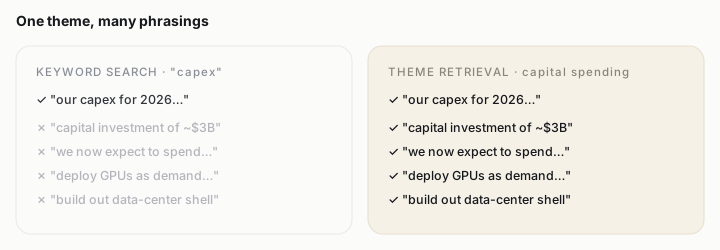
Figure 1: The same theme, expressed five ways. Keyword match sees one; theme retrieval sees all five.
This is exactly the gap a July 2025 Bloomberg paper, Agentic Retrieval of Topics and Insights from Earnings Calls (SIGIR 2025), sets out to close. Its framing: "as industries evolve, traditional topic modeling techniques struggle to dynamically capture emerging topics and their relationships." Keyword indexes and static topic models both freeze the vocabulary; earnings-call language doesn't hold still.
| Approach | What it retrieves | Where it breaks |
|---|---|---|
| Keyword search | Literal string matches | Misses paraphrase, synonyms, and new terminology |
| Static topic model | Fixed topic clusters | Can't absorb emerging topics or their relationships |
| Agentic theme retrieval | Concept-level matches over an evolving ontology | Needs structured transcripts + an entity model to run |
Source: approach limitations per Agentic Retrieval of Topics and Insights from Earnings Calls, arXiv:2507.07906.
What "agentic" retrieval actually does
The paper's method isn't "a bigger keyword index." An LLM agent extracts topics from each call, structures them into a hierarchical ontology, and establishes relationships between new and existing topics — so a theme like "AI infrastructure spending" connects to "GPU procurement," "data-center power," and "capex financing" even when no single word is shared (Gupta et al.).
| Stage | What the agent does |
|---|---|
| Topic extraction | Pulls the themes actually discussed in each call, not a fixed list |
| Hierarchical ontology | Organizes themes into parent/child structure (capex → GPU spend, power, financing) |
| Relationship mapping | Links new topics to existing ones, so emerging language attaches to known themes |
Source: method per arXiv:2507.07906.
None of this runs on raw HTML transcripts scraped ad hoc. It needs transcripts that are already segmented, speaker-mapped, and tied to a company entity model — which is the difference between an earnings call transcripts API built for agents and a bucket of text files.
The payoff: one theme, every company
Here's the query that makes the capability concrete, run live through FocusAlpha's retrieval API across neocloud earnings calls:
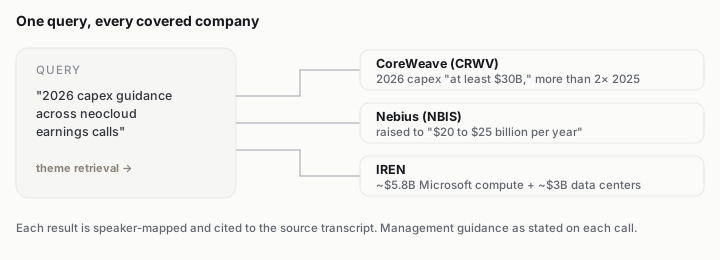
Figure 2: One theme query, structured cited answers per company — the pattern our datasets demo runs.
| Company | 2026 capital-spending guidance, as stated on its call |
|---|---|
| CoreWeave (CRWV) | "In 2026, we expect our CapEx will be at least $30 billion, more than 2x the CapEx in 2025" |
| Nebius (NBIS) | "Today we are raising our CapEx expectations to $20 to $25 billion per year" |
| IREN | ~$5.8B compute capex for its Microsoft deployment, plus ~$3B for data-center build-out |
Source: FocusAlpha retrieval across each company's earnings call; figures are management guidance as stated, not verified actuals. Retrieved July 2026.
Notice what the agent didn't have to do: find each transcript, guess each CFO's phrasing, or strip the number out of a paragraph. It asked one theme question and got structured, speaker-attributed, source-cited answers — the shape you can actually reason over, or drop into a memo, without re-checking provenance by hand.
That's the bar for an earnings call transcripts API in an agent stack: not "can it return a transcript," but "can it answer a theme across all of them, with citations." For how the same principle plays out on the accuracy side, see where earnings-call summaries quietly go wrong; for the filings equivalent, the SEC filings API checklist.
FAQ
What is an earnings call transcripts API?
A programmatic interface for retrieving earnings-call transcripts as structured data — segmented, speaker-mapped, and searchable — instead of scraped text. For AI agents, the useful ones support theme-level (semantic) retrieval and attach citations so each answer traces to the source call.
How is theme retrieval different from keyword search on transcripts?
Keyword search matches literal strings, so it misses paraphrase — "capex," "capital investment," and "we now expect to spend" are one theme in different words. Theme retrieval matches the concept, catching all phrasings; research finds that traditional topic modeling struggles to capture emerging topics, which is why agentic, ontology-based approaches are used.
Can an agent search one theme across many companies' earnings calls?
Yes — that's the core use case. With a transcripts API that supports semantic retrieval, an agent asks one theme question (e.g. "2026 capex guidance") and gets a structured, cited answer per company, instead of reading each call and reconciling phrasings itself.
What is "agentic retrieval" of earnings-call topics?
An approach where an LLM agent extracts topics from calls, organizes them into a hierarchical ontology, and links new topics to existing ones, so emerging language attaches to known themes (Gupta et al., arXiv:2507.07906). It captures evolving vocabulary that keyword indexes and static topic models miss.
Why do transcripts need to be structured for agent retrieval?
Theme retrieval needs transcripts that are segmented, speaker-mapped, and tied to a company entity model — otherwise the agent spends its budget parsing raw HTML and guessing who said what. Structure is what lets one query resolve cleanly across dozens of calls.
Does FocusAlpha offer an earnings call transcripts API?
Yes — documents lists and fetches transcripts with segment offsets, and retrieve runs semantic theme search across calls and filings, every result cited to the source. The datasets demo runs exactly the cross-company capex query above.
What is FocusAlpha?
FocusAlpha is a SEC filings API and agent-ready financial data layer: it turns SEC filings (10-K, 10-Q, 8-K, 13F), earnings-call transcripts, and other trusted company communications into structured, normalized data where every value keeps its citation back to the source document. AI agents connect via API or MCP to research public companies from complete, trusted information.