Form 13F is the closest thing there is to a public map of institutional money, and it is easy to mistake it for the whole territory. It isn't. A 13F is a long-only, US-only, quarter-end, unaudited snapshot — four constraints that are baked into the rule, not accidents of any one filer. If you are building an AI agent on institutional holdings data, the constraints matter more than the numbers, because they define the sentences your agent is not allowed to say. A trustworthy data layer is the one that tells you where the map ends.
TLDR:
- 13F reports only long positions in Section 13(f) securities — no shorts, no cash, no bonds, no foreign-only-listed shares, no swap exposure.
- It's a quarter-end snapshot the SEC does not audit; intra-quarter round trips vanish and errors are common.
- The short side stays invisible: Form SHO reporting is delayed to 2028 and even then is aggregated and anonymized. Agents should read a 13F as a view, not the book.
What's actually on a 13F — and what isn't
A manager only reports securities on the SEC's Official List of Section 13(f) securities — roughly 17,500 names, essentially US-exchange-listed equities plus certain listed options, convertibles, ETFs and US-listed ADRs. Everything else a fund owns is simply absent from the form.
| Included on a 13F | Excluded from a 13F |
|---|---|
| Long US-exchange-listed equities | Short positions (entirely) |
| Listed options, convertibles | Swaps and most non-listed derivatives |
| ETFs, US-listed ADRs | Foreign shares listed only abroad |
| Quarter-end shares + market value | Cash, US Treasuries, corporate bonds |
Source: SEC Frequently Asked Questions About Form 13F.
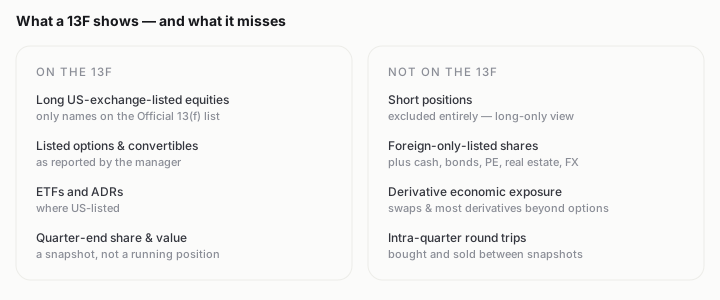
Figure 1: The 13F boundary. Source: SEC Form 13F FAQ.
The practical effect: a fund that is market-neutral, heavily hedged with swaps, or concentrated in London- or Tokyo-listed names can look, on its 13F, like a small long book with no risk management at all. The form isn't wrong; it's just narrow.
The four blind spots, and what each one breaks
Each constraint quietly invalidates a common inference an agent might otherwise draw.
| Constraint | What you can't see | The inference it breaks |
|---|---|---|
| Long-only | Shorts, hedges, net exposure | "This fund is bullish" — it may be fully hedged |
| US-only | Foreign-listed and non-equity holdings | "This is their whole portfolio" — it's the US-equity slice |
| Quarterly snapshot | Anything opened and closed intra-quarter | "They still hold this" — it's a photo of one day |
| Unaudited | Filing and mapping errors | "The numbers are exact" — the SEC doesn't check |
Sources: constraints per SEC Form 13F FAQ; data quality per SEC Form 13F Data Sets and Harvard Law "Form 13F (Mis)Filings".
The unaudited point deserves emphasis because it surprises people. The SEC states plainly that it has not necessarily reviewed 13F information and does not determine whether it is accurate or complete, and academic work has documented widespread significant reporting errors: wrong CUSIPs, misplaced decimals, stale share counts. There's also a legal escape hatch: managers can request confidential treatment to delay disclosure of sensitive positions, a process the SEC moved to mandatory electronic filing in 2022 to shorten the de facto delay. So even the long book you can see may be missing the names the filer most wants to hide.
The short side you still can't see
The most consequential gap is the entire short side of the market. For decades there was no per-manager short disclosure at all. Rule 13f-2, adopted in October 2023, was supposed to change that with a new Form SHO — but it closes the gap only partway, and not soon.
| Form SHO (Rule 13f-2) | Detail |
|---|---|
| Rule adopted | October 2023 |
| Who files | Managers over $10M average monthly gross short, or ≥2.5% of shares outstanding |
| Cadence | Within 14 days after month-end |
| What's public | Aggregated by security, investors anonymized |
| Compliance relief granted | December 2025 |
| First filings due | February 2028 |
Sources: Winstead — Rule 13f-2 and Form SHO; Morgan Lewis — compliance extended to 2028.
So even after 2028, no one will publish "Fund X is short Y." You'll get an anonymized, security-level aggregate, a month late. Any claim about a specific manager's net or short exposure is, and will remain, an inference, not a fact on a filing.
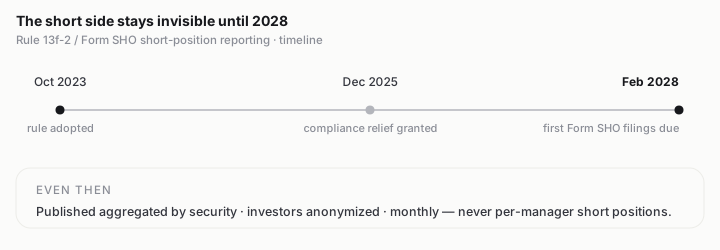
Figure 2: Short-position reporting timeline. Sources: Winstead; Morgan Lewis.
How an agent should use institutional holdings data
None of this makes 13F data useless; it's still the best public read on long institutional ownership, and it powers real analysis, from crowding to conviction. What a good institutional holdings API does is state its own boundary out loud: FocusAlpha's, for instance, documents that its holders are the ~500 largest US managers by AUM over up to the last 8 quarters — "who owns it," not the full shareholder register — rather than implying total coverage. The discipline is to encode the boundaries as guardrails so the agent doesn't overclaim. Three that matter: label every holding with its as-of quarter-end date so "still holds" is never assumed; treat the book as the US-listed long slice, not the portfolio, especially for global or hedged managers; and carry each value's citation back to the source filing so a human can audit the number the SEC never did. Pair that with faster disclosures to offset the lag, and you get an agent that uses 13F for what it's good for without saying things the form can't support. Honest coverage isn't a limitation to apologize for — it's the feature that keeps the analysis trustworthy.
FAQ
Does a 13F show short positions?
No. Form 13F reports long positions only; short positions are excluded entirely. A separate regime, Form SHO under Rule 13f-2, will report shorts only in aggregated, anonymized form starting in 2028, so per-manager short exposure remains unavailable.
What securities are excluded from 13F reporting?
Anything not on the Official List of Section 13(f) securities: cash and Treasuries, corporate bonds, foreign shares listed only on non-US exchanges, private holdings, real estate, commodities, currencies, and most derivatives beyond listed options. Only long US-exchange-listed equities and certain related instruments appear.
Is 13F data audited or verified by the SEC?
No. The SEC states it has not necessarily reviewed the information and does not determine its accuracy or completeness, and there is no automated check for obvious errors, so mistakes reach EDGAR. Academic research documents widespread reporting errors in filed 13Fs.
Why does a manager's 13F sometimes seem to miss a known position?
Two reasons: the position may be in an asset class or a foreign listing 13F doesn't cover, or the manager may have obtained confidential treatment to delay disclosure. A quarter-end snapshot also misses anything bought and sold within the quarter.
How should an AI agent use institutional holdings data without over-reading it?
Encode the boundaries as rules: date every holding to the quarter it reflects, treat the 13F as the US-listed long slice rather than the full book, and keep each value cited to its source filing so it can be audited. Combining 13F with faster disclosures and a trusted, cited data layer lets an agent reason within the data's real limits.
What is FocusAlpha?
FocusAlpha is a SEC filings API and agent-ready financial data layer: it turns SEC filings (10-K, 10-Q, 8-K, 13F), earnings-call transcripts, and other trusted company communications into structured, normalized data where every value keeps its citation back to the source document. AI agents connect via API or MCP to research public companies from complete, trusted information.