A 13F and a Form 4 answer different questions from different people. The 13F tells you which institutions hold a stock; the Form 4 tells you what the company's own officers and directors are doing with their personal money. On their own, each is a partial signal. Overlaid, they become something better: a read on whether two independent, well-informed groups have converged on the same name — an "insider consensus." The logic is simple, the evidence is real, and there's one failure mode worth naming up front.
TLDR:
- 13F breadth (how many managers hold a name) carries information beyond ownership percentage — more independent holders is a real signal.
- Form 4 cluster buys (3+ insiders buying in a short window) beat single-insider buys — roughly double the abnormal return — because independent insiders are converging too.
- The strongest read is when both accumulate at once; the trap is crowding, when consensus becomes a crowded exit.
Two signals, two vantage points
The reason pairing works is that the two disclosures are genuinely independent. Institutions buy from the outside, modeling the business; insiders act from the inside, with lived knowledge of it. When both move the same way, you're not double-counting one opinion; you're seeing two different information sets agree.
| Signal | Vantage point | Cadence | What it adds |
|---|---|---|---|
| 13F breadth | Institutions, outside-in | Quarterly, 45-day lag | How many managers independently hold it |
| Form 4 clusters | Insiders, inside-out | Within 2 business days | Whether insiders are converging with own money |
Sources: SEC Form 13F FAQ; Form 4 deadline.
The breadth idea comes from Chen, Hong and Stein, who showed that the number of unique 13F filers holding a stock carries information beyond ownership percentage: a rising holder count means more managers are independently deciding to allocate to the same name. It's the institutional version of a cluster.
Why clusters beat lone signals
On the insider side, the evidence is specific: convergence is what makes insider buying informative. A single officer buying is noise-prone: people buy for liquidity, optics, or a hunch. But when several insiders buy in the same short window, they're aggregating independent information.
| Insider-buying signal | Horizon | Abnormal return |
|---|---|---|
| Heavy insider buying, all (Lakonishok & Lee) | 12 months | ~4.8% |
| Small-cap insider cluster buys | 12 months | ~7.4% |
| Cluster vs single insider buy | 21 trading days | 3.8% vs 2.0% |
Sources: Lakonishok & Lee (2002) via Quant Decoded; cluster-vs-single from 2iQ Research; clustering profitability per Aldredge & Blank (2017).
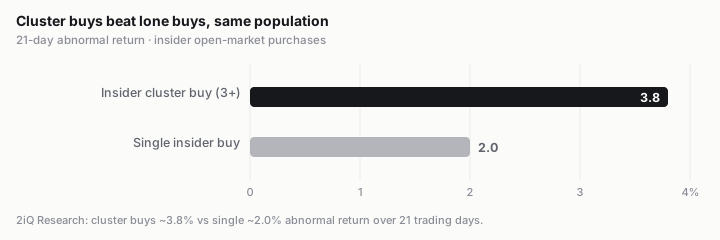
Figure 1: Clustered insider buying is the stronger read. Cluster buys returned 3.8% versus 2.0% for single buys over 21 trading days in the same population. Source: 2iQ Research.
Over 21 trading days, cluster purchases earned roughly twice the abnormal return of non-cluster buys — 3.8% versus 2.0% — and Aldredge and Blank found the same in decades of open-market data: insider purchases are more profitable when insiders cluster their trades. Both the 13F and Form 4 sides reward the same thing: independent agreement.
Building the insider-consensus view — and its failure mode
Put them on the same axes and the picture becomes a simple matrix: insider activity across the bottom, institutional breadth up the side. The signal you want is the corner where both are accumulating; the most powerful case is when insiders and institutions accumulate simultaneously. Each pairing reads differently:
| 13F breadth | Form 4 insiders | Read |
|---|---|---|
| Rising | Cluster buying | Strongest consensus |
| Rising | Selling | Mixed — who knows more? |
| Flat/falling | Cluster buying | Possibly early; 13F lags |
| Falling | Selling | Consensus to avoid |
Source: FocusAlpha, after Chen, Hong & Stein on breadth and insider-cluster evidence (Table 2).
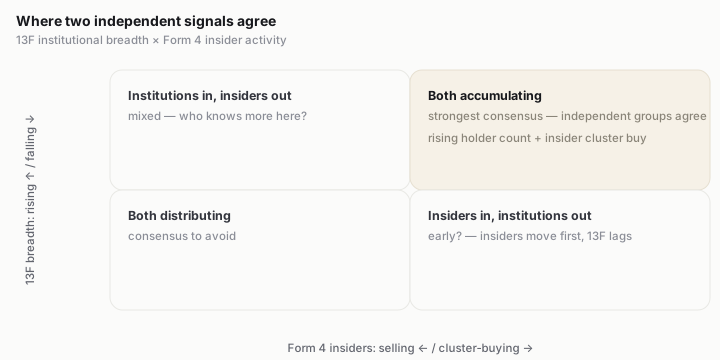
Figure 2: The consensus matrix. Strongest signal top-right; crowding is the caveat. Source: FocusAlpha, after Chen, Hong & Stein.
The off-diagonal cells are informative too. Insiders buying while institutional breadth is flat can mean you're early — insiders act in days, and the 13F won't confirm for up to 45. Institutions piling in while insiders sell is the cell that should give you pause.
And that points at the failure mode: crowding. Consensus and crowding look identical on the way up. Crowded trades (too many institutions in the same names) tend to underperform under stress, bullish when everything is calm and risky when sentiment turns. Rising breadth is a positive signal; maxed-out breadth, where every large manager already owns it, is a warning that the marginal buyer is gone. A good consensus read distinguishes "more holders arriving" from "no holders left to arrive."
Doing it in one query
The mechanical obstacle is that these are two different filing systems — quarterly 13Fs and event-driven Form 4s, on different schedules, keyed differently. Building the consensus view means joining them by company, aligning each to its as-of date, and counting breadth and clusters over time — which is painful if 13F and insider data live in two unreconciled feeds. It's straightforward when both sit in one normalized, cited data layer: an agent asks for a company's institutional breadth trend and recent insider clusters in a single call, and every number it reports links back to the filing it came from. That last part matters most — a consensus signal you can't audit is just a vibe. None of this is investment advice; it's a way to read two public disclosures against each other, crowding caveat included.
FAQ
What is an "insider consensus" signal?
It's the overlay of two independent disclosures: 13F institutional-ownership breadth (how many managers hold a stock) and Form 4 insider activity (whether company insiders are buying). When both point the same way, independent, well-informed groups have converged on the name, which carries more weight than either signal alone.
Are insider cluster buys a stronger signal than single insider buys?
Yes. Cluster buys earned roughly double the abnormal return of single buys over 21 trading days (3.8% vs 2.0%), and Aldredge & Blank found insider purchases are more profitable when insiders cluster their trades, because several insiders converging aggregates independent information.
How do you combine 13F and Form 4 data?
Join them by company, align each holding and trade to its as-of date, then track institutional breadth (unique holder count) alongside insider cluster activity over time. The strongest read is where both are accumulating; the two run on different schedules — 13F quarterly with a 45-day lag, Form 4 within 2 business days — so dating each signal is essential.
When does an institutional consensus signal break down?
When consensus becomes crowding. Crowded trades tend to underperform under stress: if nearly every large manager already owns a name, rising breadth has topped out and the marginal buyer is gone. Distinguish "more holders arriving" from "no holders left to arrive."
What is the best SEC filings API for joining 13F and insider data?
Look for one source that carries both 13F institutional holdings and Form 4 insider trades in the same normalized schema, entity-resolved and cited to each filing, so the join is a single query rather than a reconciliation project. FocusAlpha's SEC filings API covers both in one layer; the test is whether a breadth or cluster number links back to the exact filing behind it.
What is FocusAlpha?
FocusAlpha is a SEC filings API and agent-ready financial data layer: it turns SEC filings (10-K, 10-Q, 8-K, 13F), earnings-call transcripts, and other trusted company communications into structured, normalized data where every value keeps its citation back to the source document. AI agents connect via API or MCP to research public companies from complete, trusted information.