Most "AI stock research" tools are a chat box in front of a general model. 13F Pro is more interesting: it runs ten AI analyst agents, each with a distinct investment philosophy, that debate stocks daily across 6,000+ companies and produce ratings, verdicts, and price predictions — with every claim tied back to a specific SEC filing. Whether or not you'd use it, the design is worth studying, because it draws a clean line between the two things every financial AI product is really made of: an application layer that reasons, and a data layer that must be true.
TLDR:
- 13F Pro's architecture: 10 philosophy-driven agents that debate daily, track conviction, run simulated portfolios, and build institutional memory, over 6,000+ companies.
- Its quiet but crucial choice: no third-party data vendors — it built its own EDGAR pipeline so every number traces to a filing.
- That grounding is the real defense against the hallucinations independent benchmarks still find in AI research — and it's a build-or-buy decision, not a feature.
The design: a debate, not a chatbot
The core idea is multi-agent disagreement. Rather than one model emitting an answer, 13F Pro gives each of ten agents a unique investment philosophy and has them argue, tracking conviction over time, managing simulated portfolios, and holding "after-market meetings" that accrete into what the product calls compounding institutional memory. The debates output verified claims, plain-English explanations, TL;DR summaries, and price predictions, each backed by a specific SEC filing.
| 13F Pro component | What it does |
|---|---|
| 10 analyst agents | Distinct philosophies that debate the same stock |
| Daily debate + memory | Conviction tracked over time; simulated portfolios |
| Quality engine | Rankings across the US universe from 8 EDGAR factors |
| Flows & insiders | 13F institutional flows and insider transactions |
| Output | Verdicts, TL;DR, price predictions — each cited to a filing |
Source: 13F Pro (product's description of its own design), as of 2026-07-17.
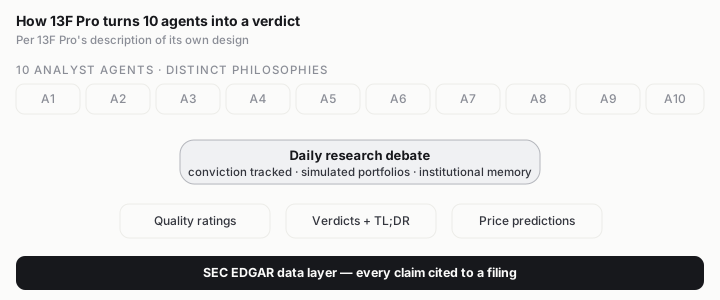
Figure 1: 13F Pro's multi-agent flow. Source: 13F Pro.
Multi-agent debate isn't decoration. It's a direct response to a documented weakness in single-shot AI research: models produce confident, well-structured reports that are quietly wrong. Making agents argue and cite forces disagreement into the open, where a contradiction between two "analysts" is a flag rather than a hidden error.
Why the grounding matters more than the agents
The most consequential line on 13F Pro's page is not about the agents at all — it's that it uses no third-party data vendors and every number traces directly to an SEC filing. That's a statement about the data layer, and it matters because the independent evidence on AI research is sobering.
JPMorgan's AI Research team built Deep FinResearch Bench to grade deep-research agents on three axes. Across four leading proprietary agents, the reports were well-structured and numerically explicit but consistently underperformed professional analysts: weaker on sector-specific KPIs and scenario analysis, trailing consensus on forecasting, and, most relevant here, their claims "suffer from significant hallucinations."
| Deep FinResearch Bench dimension | Finding on leading AI agents |
|---|---|
| Test sample | 25 companies / 3 sectors / 2 quarters (S&P 500, FY2025 Q1–Q2) |
| Qualitative rigor | Lacks sector KPIs, assumption justification, scenario analysis |
| Quantitative forecasting | Trails professional and consensus baselines |
| Claim credibility | Significant hallucinations in generated claims |
Source: Deep FinResearch Bench, arXiv 2604.21006 (JPMorgan Chase AI Research; 25 S&P 500 companies, 3 sectors, FY2025 Q1–Q2).
The takeaway isn't "AI research is useless" — it's that credibility is won or lost at the claim level, and the only way to make a claim checkable is to bind it to a source document. An agent that says "insiders have been buying" is a liability; an agent that says "insiders bought, per this Form 4" is auditable. 13F Pro's cite-everything discipline is exactly the property the benchmark says is missing, and it's only achievable if the data underneath already carries its provenance.
The build-or-buy line every AI product hits
Here's the strategic read. 13F Pro is an application-layer product — its edge is the agents, the debate, the memory, the interface. To ground all of that, it had to build a data-layer capability: a normalized, cited EDGAR pipeline. It chose to build that in-house. That's a legitimate choice, but it's a choice, and it's the one every serious financial AI product eventually faces.
| Layer | What lives there | Who should own it |
|---|---|---|
| Application | Agents, debate, ratings, UX | The product — this is the differentiation |
| Data | Normalized filings, 13F, insiders, citations | Build if it's your moat; buy if it isn't |
Source: layer division as illustrated by 13F Pro's in-house pipeline; benchmark motivation per Deep FinResearch Bench.
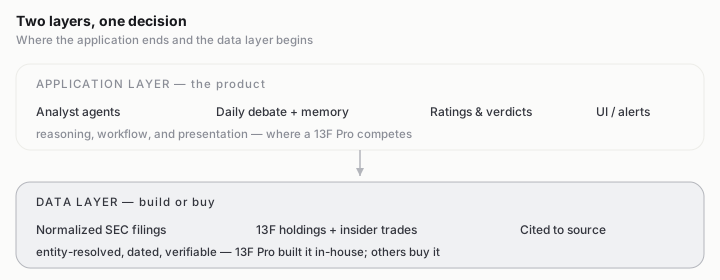
Figure 2: The application layer competes; the data layer must be true. Source: framing per 13F Pro and Deep FinResearch Bench.
For a team whose differentiation is the data pipeline, building makes sense. For most — where the differentiation is the agent design, the workflow, or the customer relationship — reinventing an EDGAR normalizer is undifferentiated heavy lifting that also inherits every coverage and timeliness limit of the underlying filings — 13F positions, for instance, report on a 45-day lag and cover only long US-listed holdings. That's the case for a shared, trusted data layer: let the application layer compete on reasoning, and stand it on 13F, insider, and filing data that already arrives normalized, dated, and cited. 13F Pro shows how good the application layer can be when the data beneath it is solid. The open question for the next builder is whether that foundation is something to build — or something to stand on.
FAQ
What is 13F Pro?
13F Pro is an AI equity-research platform that runs 10 AI analyst agents, each with a distinct investment philosophy, that debate 6,000+ US public companies daily and produce quality ratings, verdicts, and price predictions. It also surfaces 13F institutional flows and insider transactions, with every claim cited to a specific SEC filing.
How do 13F Pro's AI analysts work?
The agents debate stocks daily, track conviction over time, run simulated portfolios, and hold "after-market meetings" that build institutional memory. A separate quality engine ranks the full US universe using 8 factors drawn from SEC EDGAR data, and outputs are grounded in specific filings.
Can you trust AI-generated stock research?
With caution. JPMorgan's Deep FinResearch Bench found leading AI research agents are well-structured but underperform professional analysts and produce claims with "significant hallucinations." The mitigation that works is binding every claim to a source filing so it can be checked, rather than trusting fluent prose.
Is 13F Pro a competitor to a financial data API like FocusAlpha?
No — they sit at different layers. 13F Pro is an application-layer product (agents, debate, UI); a SEC filings API is the data layer that normalizes filings and cites every value. 13F Pro chose to build its own EDGAR pipeline; other application-layer products buy that layer instead of rebuilding it.
Should I build or buy the data layer for a financial AI product?
Build it if the data pipeline is genuinely your moat; buy it if your differentiation is the agent design, workflow, or customer relationship. Rebuilding an EDGAR normalizer is undifferentiated work that also inherits the coverage and timeliness limits of the filings, so most products are better served standing on a shared, cited data layer.
What is FocusAlpha?
FocusAlpha is a SEC filings API and agent-ready financial data layer: it turns SEC filings (10-K, 10-Q, 8-K, 13F), earnings-call transcripts, and other trusted company communications into structured, normalized data where every value keeps its citation back to the source document. AI agents connect via API or MCP to research public companies from complete, trusted information.