Two of the most-watched value-investing houses filed their Q1 2026 13Fs on the same day, and they told a strikingly similar story. Berkshire Hathaway — in its first 13F under new CEO Greg Abel, with Warren Buffett now chairman — tripled its Alphabet stake into its largest technology position while dumping sixteen names. Li Lu's Himalaya Capital, meanwhile, now holds a book that is roughly 45% Alphabet. Both trimmed a legacy financial and rotated toward high-moat compounders. It's a clean case study in reading institutional holdings data, including the part where the data is already a quarter old.
TLDR:
- Berkshire's Q1 2026 13F (as of 3/31/2026, $263B, 29 holdings) tripled Alphabet to ~$16.6B and exited Visa, Mastercard, UnitedHealth, Amazon and more.
- Himalaya's $3.2B book is now anchored on Alphabet A+C (~45%), with new S&P Global and Moody's stakes and a 71% cut to Bank of America.
- The overlap on Alphabet is real — but this is a 3/31 snapshot filed 5/15; by mid-July it's a quarter stale, and Q2 filings aren't due until mid-August.
Berkshire's first post-Buffett filing
Abel's debut 13F was not a caretaker's. Berkshire's equity book shrank from roughly $274B to $263B and cut sixteen names, many of them long-held Buffett-era positions. The standout move was Alphabet: the combined stake was tripled to about $16.6B, vaulting it into Berkshire's top seven and making it the firm's largest technology position — but at #7 by value it still sits behind Chevron and Occidental, not inside the top five.
| Berkshire Q1 2026 move | Detail |
|---|---|
| Portfolio value | ~$274B → ~$263B (29 holdings) |
| Alphabet | Tripled to ~$16.6B — new top-7 holding, largest tech position (added ≈ $11B) |
| New: Delta Air Lines | ~39.8M shares, ~$2.6B |
| Exited: Visa | ~$2.91B |
| Exited: Mastercard | ~$2.28B |
| Exited: UnitedHealth | ~$1.66B |
| Exited: Domino's / Amazon | ~$1.40B / ~$0.53B |
Source: SEC EDGAR — Berkshire Hathaway 13F-HR, filed 2026-05-15, as of 3/31/2026; UnitedHealth exit corroborated by Reuters/Yahoo.
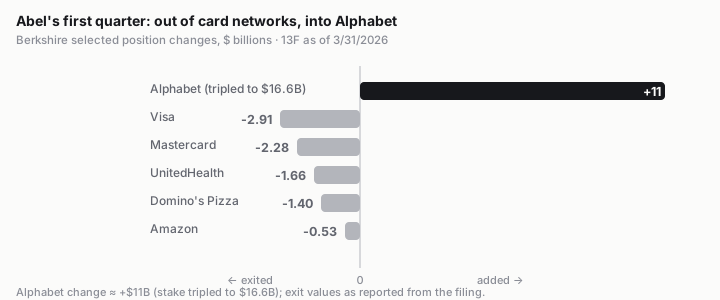
Figure 1: Berkshire's Q1 2026 rotation. Source: SEC EDGAR — Berkshire Hathaway 13F-HR, as of 3/31/2026.
The core is unchanged: Apple, American Express, Coca-Cola, Bank of America and Chevron still make up the bulk of the book. But the direction of travel is out of the card networks and into a mega-cap that is, among other things, an AI-infrastructure story.
Li Lu's book became an Alphabet book
Himalaya Capital ran the same play with far more concentration. Once a Bank of America-led portfolio, Li Lu's Q1 2026 filing shows 14 holdings worth $3.2B, and the top of the book is now almost entirely Alphabet: Class A and Class C together are about 45% (22.85% + 21.97%).
| Himalaya Q1 2026 top holding | % of portfolio |
|---|---|
| Alphabet Class A (GOOGL) | 22.85% |
| Alphabet Class C (GOOG) | 21.97% |
| Pinduoduo ADR (PDD) | 14.71% |
| Berkshire Hathaway Class B | 13.44% |
| East West Bancorp (EWBC) | 9.26% |
Source: SEC EDGAR — Himalaya Capital Management 13F-HR, filed 2026-05-15, as of 3/31/2026; weights are each holding's value as a share of the $3.2B book.
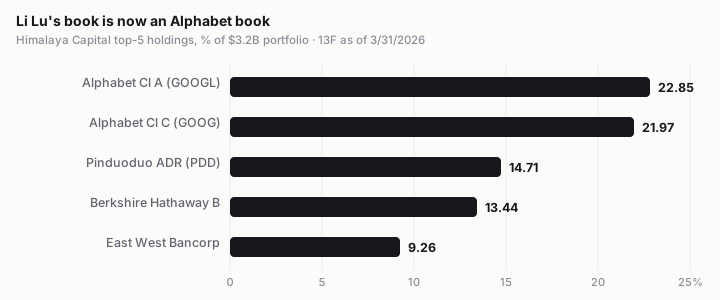
Figure 2: Himalaya's concentration. Source: SEC EDGAR — Himalaya Capital Management 13F-HR, as of 3/31/2026.
The changes underneath echo Berkshire's. Li Lu cut Bank of America by more than 71% and opened new stakes in S&P Global and Moody's — two of the highest-moat, best-cash-flow franchises in finance, the kind of "toll-booth" data businesses value investors prize.
The Q1 2026 13F convergence — and its limits
Line the two up and the pattern is hard to miss: same top conviction, same rotation out of a legacy financial, same drift toward durable compounders.
| Theme | Berkshire (Abel) | Himalaya (Li Lu) |
|---|---|---|
| Top new conviction | Alphabet tripled, now top-7 | Alphabet A+C ≈ 45% of book |
| Trimmed legacy financial | Exited Visa & Mastercard | Cut Bank of America >71% |
| Toward high-moat compounders | New Delta, still building NYT (~$1.27B) | New S&P Global, Moody's |
Sources: SEC EDGAR — Berkshire Hathaway 13F-HR and Himalaya Capital 13F-HR, both as of 3/31/2026. New York Times grew from ~5.1M to ~15.1M shares ($0.35B → $1.27B).
Two independent, disciplined shops landing on Alphabet at the same time is a genuine signal of where quality-focused capital sees durable advantage. But it is worth being precise about what a 13F can and can't tell you here. This is a snapshot as of March 31, filed May 15 — under the SEC's 45-day rule — so by the time you read it in July, both managers have had a full quarter to change their minds, and the signal has been decaying the whole time. It's also a long-only, US-listed view: Himalaya's overseas or hedged exposure, if any, simply isn't on the form. Read as history, the convergence is instructive. Read as a live trade ticket, it's already out of date.
That gap between "what the filing says" and "what's true today" is exactly why cross-manager 13F work belongs on a data layer that dates every holding and cites every number back to its filing — so an analyst, or an agent, can see the freshness of each figure at a glance instead of quietly assuming it's current. None of the above is investment advice; it's a reading of public filings, with their limits attached.
FAQ
What did Berkshire Hathaway buy and sell in Q1 2026?
In its first 13F under CEO Greg Abel, Berkshire tripled its Alphabet stake to about $16.6B, opened a ~$2.6B Delta Air Lines position, and exited sixteen names including Visa, Mastercard, UnitedHealth, Domino's and Amazon. The book shrank from ~$274B to ~$263B across 29 holdings.
What is in Li Lu's Himalaya Capital portfolio in 2026?
As of the Q1 2026 13F, Himalaya held 14 positions worth $3.2B, led by Alphabet Class A (22.85%) and Class C (21.97%), Pinduoduo (14.71%), Berkshire Hathaway B (13.44%) and East West Bancorp (9.26%). Li Lu also cut Bank of America over 71% and added S&P Global and Moody's.
Did Buffett or Abel make Berkshire's Q1 2026 trades?
The Q1 2026 13F is filed by Berkshire and is the first since Greg Abel became CEO; Buffett remains chairman. Attributing specific trades to one person isn't possible from the form, which reports the firm's holdings, not who decided them.
How current is 13F data when I read it?
Not very. A 13F reports holdings as of quarter-end and is due up to 45 days later, so a Q1 filing read in mid-July is already about three and a half months old, and the next quarter's filings aren't due until mid-August. Treat 13F holdings as history, not a live position feed.
How can an AI agent analyze 13F filings across multiple managers?
It needs institutional holdings data normalized across filers, with each holding carrying its as-of date and a citation to the source 13F, so cross-manager comparisons line up and stay auditable. A SEC filings API that returns entity-resolved, cited holdings lets an agent compute overlaps like the Berkshire–Himalaya Alphabet convergence without stitching together inconsistent trackers.
What is FocusAlpha?
FocusAlpha is a SEC filings API and agent-ready financial data layer: it turns SEC filings (10-K, 10-Q, 8-K, 13F), earnings-call transcripts, and other trusted company communications into structured, normalized data where every value keeps its citation back to the source document. AI agents connect via API or MCP to research public companies from complete, trusted information.